- The commercial property market is changing, and what businesses look for in a workspace or retail location is not necessarily the same as it was a few years ago.
- According to Cytonn Research's Q3 2026 Markets Review, Nairobi Metropolitan Area had an estimated office space oversupply of 3.4 million square feet.
- Since the Covid-19 pandemic, some businesses have adopted hybrid working arrangements, allowing employees to work partly from home and partly from the office.
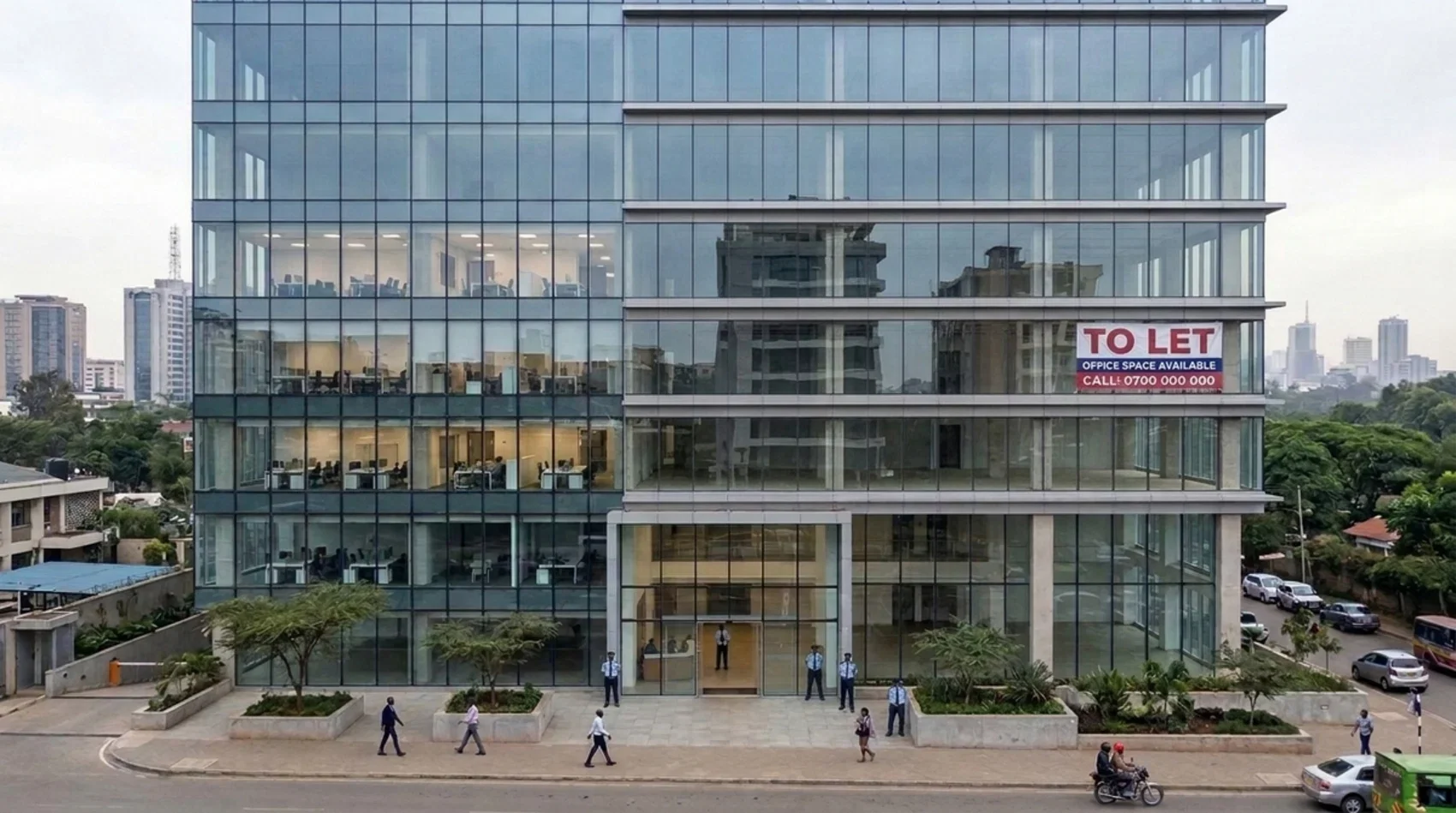
Take a drive through parts of Nairobi, and you'll notice something interesting. New office blocks, shopping centres and commercial developments continue to shape the city's skyline. But alongside these developments, some buildings still have vacant offices and shops, with spaces advertised for rent for months.
It raises an interesting question. If businesses need office space and shops, why are some commercial buildings struggling to find tenants?
The answer is not as simple as having too many buildings. The commercial property market is changing, and what businesses look for in a workspace or retail location is not necessarily the same as it was a few years ago.
READ ALSO: Why Investors Are Moving From Office Buildings to Warehouses in Kenya
There is more office space than the market can absorb
One of the biggest challenges facing Nairobi's commercial property market is oversupply.
For years, developers invested heavily in office buildings, particularly in areas such as Westlands, Upper Hill, Kilimani and the Nairobi CBD. The expectation was that more businesses, multinational companies and organisations would need office space.
However, the supply of new offices grew faster than demand in some parts of the market.
According to Cytonn Research's Q3 2026 Markets Review, Nairobi Metropolitan Area had an estimated office space oversupply of 3.4 million square feet. While office occupancy improved to 84.7% in Q3 2026, up from 82.4% during the same period in 2025, the market still has a considerable amount of space to absorb.
This means landlords are competing for a smaller pool of available tenants, particularly in buildings that offer similar facilities and are located within the same neighbourhoods.
Businesses are changing how they use office space
The way companies work has also changed.
Since the Covid-19 pandemic, some businesses have adopted hybrid working arrangements, allowing employees to work partly from home and partly from the office. Others have reduced their office space or moved into smaller, fitted-out premises.
For a business that no longer needs an entire floor, taking up a large office may not make financial sense.
This has affected demand for traditional office spaces, especially larger units that may require tenants to spend more on rent, furniture, utilities and maintenance.
At the same time, coworking spaces and serviced offices are giving businesses more flexible options. Instead of committing to a long lease and setting up an entire office, smaller companies can access shared workspaces and facilities as needed.
This means landlords have to think beyond simply having an office available. They also need to consider how businesses want to use that space.
Not every building offers what tenants need
Location is important, but it is not the only thing businesses consider when choosing an office.
A building may be in a popular commercial area, but if it lacks reliable backup power, adequate parking, good security, proper ventilation or reliable property management, it may struggle to compete with other developments.
Businesses also consider the cost of operating from a particular building. Rent is only one part of the expense. Electricity, service charges, internet, parking and maintenance can increase the overall cost of occupying a space.
This is why some businesses are willing to pay more for a well-managed office that offers the facilities they need, while others may prefer a smaller and more affordable alternative.
In fact, Knight Frank's Africa Office Market Review for the first half of 2026 noted that tenants are increasingly prioritising modern specifications, energy efficiency, reliable backup power, parking and tenant amenities when choosing office space.
Location and accessibility still matter
Two commercial buildings can be in the same town but attract very different levels of interest.
Think about a business that needs its customers to visit regularly. Access to the building, available parking, public transport connections and the surrounding businesses can influence whether that location makes sense.
For retail spaces, foot traffic is particularly important. A shop may have attractive interiors and competitive rent, but if it is in an area with limited customer movement, attracting and retaining customers can be difficult.
The surrounding neighbourhood also matters. Businesses want to be where their customers are, whether that means being close to residential estates, offices, transport routes or other commercial activities.
This is why choosing a commercial property based on location alone may not always deliver the expected results.
Shopping habits are also changing
The growth of online shopping has introduced another challenge for traditional retail spaces.
Today, customers can order groceries, electronics, clothing and other products online without necessarily visiting a physical shop.
For retailers, this means they have to think differently about how they use physical stores. Some use them as showrooms, collection points or spaces where customers can experience products before buying.
However, this does not mean physical retail spaces are no longer relevant. Shopping centres still attract customers looking for supermarkets, restaurants, entertainment, personal services and convenient shopping experiences.
In fact, Cytonn's Q3 2026 review recorded retail occupancy in the Nairobi Metropolitan Area at 87.9%, up from 84.8% in Q3 2025. This shows that demand for retail space remains, although performance differs depending on the location, quality and type of development.
READ ALSO: Co working: The Future Of Office Space in Kenya
What does this mean for property developers and landlords?
The commercial property market is becoming more competitive, and simply putting up a building in a popular neighbourhood may not be enough to guarantee tenants.
Developers need to understand what businesses in a particular area actually need before deciding what type of space to build. This includes the size of the units, rental prices, accessibility, facilities and the type of businesses likely to occupy them.
Landlords, on the other hand, may need to rethink how they manage and market existing spaces. This could mean improving facilities, reviewing rental terms, offering flexible office arrangements or upgrading older buildings to meet current tenant expectations.
Ultimately, commercial property is not just about how many buildings are available. It is about whether those buildings serve a real business need.
As Nairobi continues to grow, there will still be demand for offices, shops and other commercial spaces. But the developments that attract tenants will increasingly be those that understand what businesses need, where they need it and what they can afford.