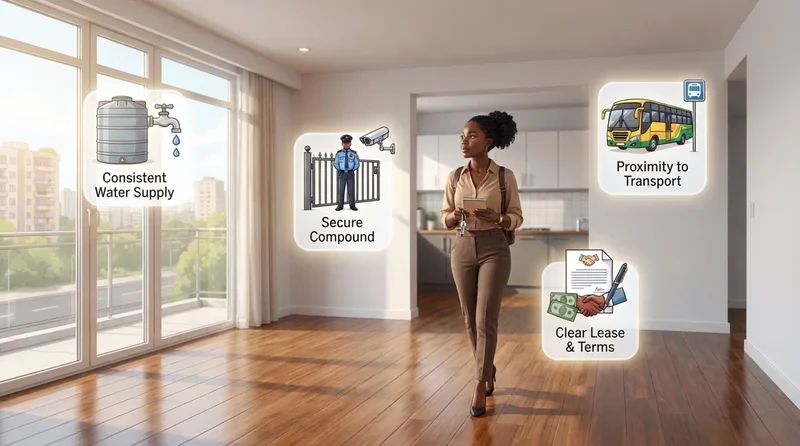
- You have some savings, but not enough to buy it outright, so you decide to take a mortgage.
- Interest isn’t the only thing you need to budget for. Buying a home can come with other costs such as valuation, legal fees, insurance, stamp duty and applicable bank charges.
- A mortgage can make buying a home possible without having the full purchase price sitting in your bank account. It is also a long-term financial commitment.
- When you’re buying a home, don’t just ask: “Can I afford the house?”, ask, “Can I afford the cost of borrowing the money to buy it?”
You find a house you like. It costs KSh5 million.
You have some savings, but not enough to buy it outright, so you decide to take a mortgage.
The question then becomes: How much will that KSh5 million house actually cost you?
And the answer may surprise you.
Because when you buy a home with a mortgage, you are not just paying for the house. You are also paying the bank for lending you the money.
That is the true cost of borrowing.
READ ALSO: Why Most Kenyans Fear Mortgages (And Whether They Should)
Table of Contents
Let’s do the maths
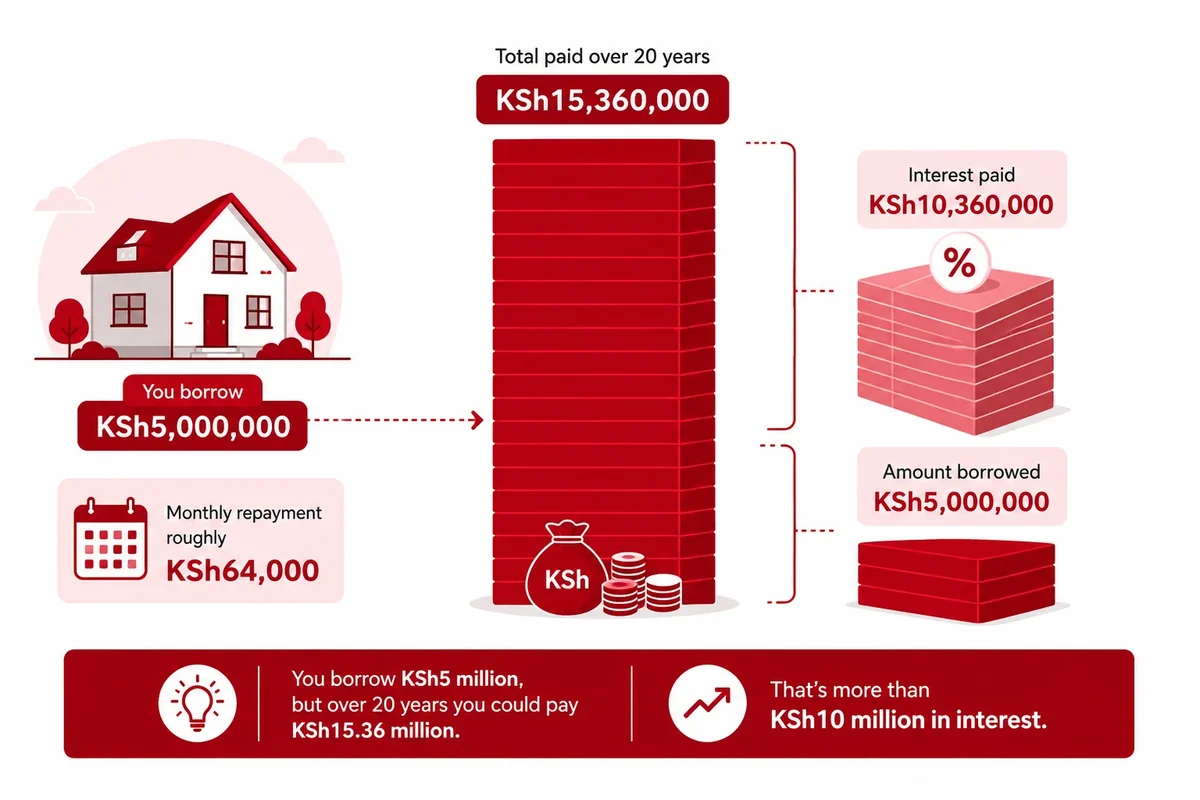
Let’s say you borrow KSh5 million for 20 years at an illustrative interest rate of 14.5% per year.
Your monthly repayment would be roughly KSh64,000.
At first, you might look at that and think, “Okay, KSh64,000 a month. I can work with that.”
But now look at the bigger picture.
Over 20 years, those monthly payments would add up to about KSh15.36 million, before any additional fees and charges.
So you borrowed KSh5 million, but you could end up paying around KSh15.36 million over the life of the loan.
That’s more than KSh10 million in interest.
And this is why looking only at the monthly repayment can be misleading.
The figures above are an illustration, not a quote from a specific bank. Actual mortgage rates, fees and repayment structures vary.
So why is the difference so big?
It’s mainly because of time. When you take a mortgage, you pay interest on what you owe.
As you make your monthly payments, part goes towards the loan itself, the principal, and part goes towards interest.
The longer you take to repay the mortgage, the longer you are paying interest.
This is why a 25-year mortgage can look attractive compared with a 15-year mortgage. Your monthly payment will generally be lower because you have more time to pay. But you could end up paying much more overall.
So when comparing mortgages, don’t just ask:
“Can I afford the monthly payment?”
Also ask:
“How much will this mortgage cost me altogether?”
That second question is really important.
A cheaper monthly payment doesn’t necessarily mean a cheaper loan
Let’s say you have the option of taking a mortgage over 15, 20 or 25 years.
The longer option may make your monthly budget more comfortable.
And sometimes that is exactly what you need.
But there is a trade-off.
More years to repay = more time paying interest.
So you have to find a balance between a monthly payment you can comfortably manage and a loan term that doesn’t leave you paying significantly more than necessary.
It’s not always about choosing the shortest mortgage term possible.
It’s about understanding what each option actually costs you.
Then there are the other costs
Interest isn’t the only thing you need to budget for.
Buying a home can come with other costs such as valuation, legal fees, insurance, stamp duty and applicable bank charges.
The Kenya Bankers Association recommends looking at the Total Cost of Credit, rather than focusing only on the advertised interest rate. This gives you a clearer picture of what the loan will actually cost you.
So if you’re comparing two mortgage offers, don’t simply look at:
Bank A: 13%
Bank B: 14%
and assume Bank A is automatically cheaper.
Look at the bigger picture.
What fees are involved? What is the repayment period? Is the rate fixed or variable? And most importantly, how much will you have paid by the end?
What happens if your interest rate changes?
This is another thing people sometimes overlook.
Not all mortgages have an interest rate that stays the same throughout the loan.
With a variable-rate mortgage, your rate can change depending on the terms of the loan and the benchmark it is linked to.
Kenya’s current loan-pricing framework uses KESONIA as the common reference rate for variable-rate loans, with the lender adding its own premium and applicable fees and charges. (centralbank.go.ke)
In simple terms, this means your mortgage payment isn’t necessarily something you can assume will stay exactly the same for the next 20 years.
That’s why it’s worth asking your bank:
Is my rate fixed or variable?
And if it’s variable:
What could make it go up or down?
Before you sign, look beyond the house price
A mortgage can make buying a home possible without having the full purchase price sitting in your bank account.
It is also a long-term financial commitment.
So before signing, don’t just focus on whether you qualify or whether you can manage the monthly payment.
Look at:
- The interest rate — Is it fixed or variable?
- The loan term — How many years will you be paying?
- The monthly repayment — Can you comfortably afford it?
- The total cost — How much will you have paid by the end?
- The additional costs — What fees and charges come with the loan?
- Early repayment terms — What happens if you want to pay off the mortgage sooner?
The Kenya Bankers Association also has a Total Cost of Credit tool that borrowers can use when comparing loan offers. (kba.co.ke)
Conclusion
A KSh5 million house doesn’t necessarily cost KSh5 million when you buy it with a mortgage.
The mortgage makes it possible to spread the cost over many years, but those years come with a price, interest.
And that’s not necessarily a reason to avoid borrowing.
It’s simply a reason to understand the numbers before you commit.
Because when you’re buying a home, don’t just ask:
“Can I afford the house?”
Ask:
“Can I afford the cost of borrowing the money to buy it?”
That is a much better question to start with.
READ ALSO: Types of Mortgages in Kenya: A Simple Guide for Homebuyers