Finding your dream home sounds simple until you actually start looking.
Suddenly, there are dozens of neighbourhoods to consider, hundreds of listings to scroll through and a long list of things you didn't realise you cared about. Is the apartment big enough? Is the neighbourhood convenient? Can you afford it comfortably? And what about parking, security, water and internet?
It is easy to get carried away by a beautiful living room or a great view. But before you fall in love with a property, there are a few things worth considering.
READ ALSO: The Perfect Match: How to Find Your Dream Home
Start With What You Actually Need
Before you start searching, make a list of your must-haves.
How many bedrooms do you need? Do you need parking? Are you looking for a home office, a balcony, a garden or a pet-friendly building? If you have children, proximity to schools may be important. If you commute to work every day, the location could be one of your biggest priorities.
Then separate your needs from your wants.
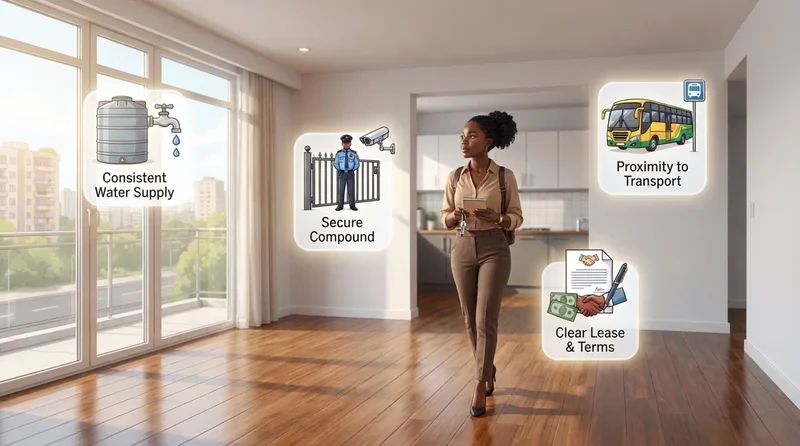
A swimming pool may be nice to have, but reliable water, security and easy access to work may matter more in your day-to-day life.
Knowing the difference can make your search much easier.
Know What You Can Comfortably Afford
Your budget should go beyond the advertised rent or purchase price.
If you are renting, remember to factor in the deposit, service charge where applicable, utilities, parking and moving costs.
If you are buying, there are additional costs to consider, including your deposit, legal fees, valuation, stamp duty, mortgage-related costs and ongoing maintenance.
The goal isn't just to find a home you can technically afford. It is to find one that you can comfortably afford without stretching your finances too far.
Think About the Neighbourhood, Not Just the Property
You may love the apartment, but do you love where it is?
Think about your daily routine. How long will it take to get to work? Are there supermarkets, restaurants, schools and healthcare facilities nearby? Is public transport easily accessible? What is the road like during rush hour?
It can also help to visit the area at different times of the day.
A neighbourhood can feel completely different on a quiet Saturday afternoon compared with a weekday morning.
And if you're unsure where to start, comparing different neighbourhoods can help you understand what your budget gets you in each one.
Don't Judge a Home From the Photos
Property photos are useful, but they don't tell you everything.
A spacious-looking living room may feel very different in person. Photos won't tell you whether there is enough natural light, how noisy the road is or whether the water pressure is reliable.
When viewing a property, pay attention to things that aren't immediately obvious.
Check the condition of the walls, floors, windows and fittings. Ask about water supply, electricity, internet connectivity, parking and security. If it is an apartment, find out what the service charge covers.
These may not be the most exciting things to look at, but they can make a big difference once you move in.
Look Beyond the Four Walls
Your home is more than the building itself.
Look at the estate, apartment complex or development as a whole. Is it well maintained? Is there enough visitor parking? How is waste managed? Are common areas clean? Is the building secure?
For buyers, it is also worth thinking about how the property and surrounding area could change over time.
New roads, businesses, schools and other developments can change how convenient an area is and potentially how attractive it becomes to future buyers or renters.
Compare Before You Decide
Finding a property you like does not mean you have to stop looking.
Compare similar properties in the same neighbourhood and price range. Look at what you are getting for your money and where there are differences.
One apartment may be slightly more expensive but offer more space. Another may be cheaper but have better access to amenities. A third may have great finishes but a longer commute.
Comparing your options makes it easier to see what actually offers value for your budget.
Think About Your Future
Your needs today may not be the same a few years from now.
Maybe you are planning to start a family. Perhaps you will need a home office. You may want an extra bedroom or more outdoor space.
You don't need to predict everything that could happen, but it is worth asking whether the property gives you enough flexibility.
This is particularly important when buying, because you are likely to live with that decision for much longer than you would with a rental.
Take Your Time
There is no single definition of a dream home.
For one person, it might be a three-bedroom house with a garden. For another, it could be a compact apartment close to work, with everything they need within walking distance.
The important thing is to find a property that works for your lifestyle, your priorities and your budget.
So before you make that decision, look beyond the photos. Explore the neighbourhood, compare your options, ask questions and think about what everyday life will actually look like there.
Because the right home isn't necessarily the biggest, newest or most expensive one.
It is the one that works for you.
READ ALSO: Designing Your Dream Space: Where Style Meets Functionality