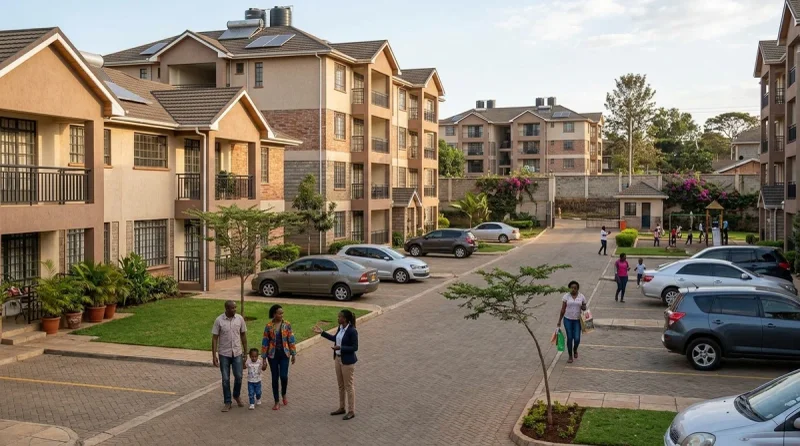
Kenya’s real estate market has been and still is on an upward trajectory. If you visited the country ten years ago, you’d be amazed at how much has changed. Places that were once open fields are now dotted with high-rises, apartment blocks, and gated estates.
But even with this remarkable progress, Kenya still lags behind a more mature market like South Africa. In many ways, we’re where South Africa was about 10 or 15 years ago, full of promise, energy, and growth, but still tightening the bolts on structure and systems.
And that’s not a bad thing. In fact, it’s a strategic advantage. Because if we pay attention, we can learn from the paths others have already walked; borrow what worked, avoid what didn’t, and build a real estate industry that’s truly our own.
South Africa’s property market runs on structure, data, and decades of experience. Up here in Kenya, we’ve got energy — a fast-growing, bold market that’s still shaping its identity.
We’re both building, just at different stages of the journey. And when you really think about it, Kenya today looks a lot like where South Africa once stood. Which means we don’t have to reinvent the wheel, just learn how to steer it better.
So, what exactly can we pick from South Africa’s real estate playbook, and how does it fit into Kenya’s story? Let’s dive in.
READ ALSO: Most Expensive Cities to Live in Africa in 2023
Table of Contents
One Runs on Structure, the Other on Drive
If there’s one thing South Africa nailed early, it’s regulation and structure. Their real estate industry runs on established frameworks, strong property laws, and a mature mortgage system. You can see the difference in how property transactions flow; less chaos, more clarity.
Kenya, on the other hand, is still figuring out the systems part. Land records? Often messy. Regulation? Improving, but still catching up. Yet what we lack in structure, we make up for in energy. Our developers are fearless, our buyers are curious, and the market keeps moving even in tough times.
If we can combine that entrepreneurial fire with South Africa’s discipline, we’d have a near-perfect balance.
Mortgages Done Right
In South Africa, mortgages drive home ownership. According to the Centre for Affordable Housing Finance (CAHF), nearly 70% of home buyers use mortgage financing.
In Kenya, that number is less than 3%.
That tells you everything about the gap. South Africa’s financial systems make it possible for ordinary people to buy homes and pay comfortably over time. Kenya’s housing dream, meanwhile, still leans heavily on cash buyers and developers targeting the upper middle class.
If Kenya wants a truly inclusive property market, access to affordable financing has to move from conversation to priority. Improving people’s purchasing power would lift the entire market.
Another leaf Kenya’s real estate industry can borrow from South Africa is the culture of long-term planning and professional property management. South Africa’s developments don’t just focus on building, they focus on sustainability: proper maintenance, transparent homeowners’ associations, and strong rental management systems. That structure keeps property values stable long after construction ends.
If Kenya could pair its growth momentum with that kind of discipline, we’d build not just homes, but housing ecosystems that last.
A Growth Story That Needs Structure
When it comes to growth, Kenya’s real estate industry is the very definition of it. It may not be fully structured yet, but it’s full of life. Demand is real, cities are expanding fast, and new roads keep opening up areas that once felt too far to live in. Towns like Ruaka, Ruiru, and Kitengela, once quiet and overlooked, are now lively residential hubs.
South Africa’s market, on the other hand, is mature and well-organized. Growth there has slowed, but the systems work. Kenya still has that early-stage energy, the kind that makes things move and keeps opportunities coming.
That energy is a good thing, but it needs direction. South Africa’s journey shows what can happen when growth runs ahead of balance; too many luxury homes, not enough affordable ones, and rising costs that lock out many middle-income buyers. Kenya can learn from that and grow smarter.
If we plan better, improve regulation, expand mortgage access, and build where real demand exists, we can keep the energy without repeating South Africa’s mistakes.
Building With Facts, Not Just Instinct
Strong markets are built on more than concrete and ambition, they’re built on information. And in that regard, South Africa is miles ahead. Developers and investors there rely on solid research before making moves. Housing reports, pricing trends, and vacancy rates are easy to access, and people trust the numbers.
In Kenya, many decisions still come down to “gut feeling.” Developers often build what looks hot rather than what data supports. The result? Too many luxury apartments and not enough homes where the real demand lies.
For Kenya to mature, we need a stronger data culture, one where numbers guide strategy, not just instinct.
Lessons worth noting
South Africa shows us what a stable, well-structured property market can look like. Kenya shows what’s possible when innovation meets demand. Somewhere between their system and our spirit lies the sweet spot; a market that’s both sustainable and full of opportunity.
Kenya doesn’t need to copy South Africa’s playbook word for word. But we can definitely learn from the chapters they’ve already written, especially around financing, data, and long-term planning.
Because in the end, real estate isn’t just about buildings. It’s about how a country grows and whether the people grow with it.
READ ALSO: 5 Magnificent Buildings in Africa